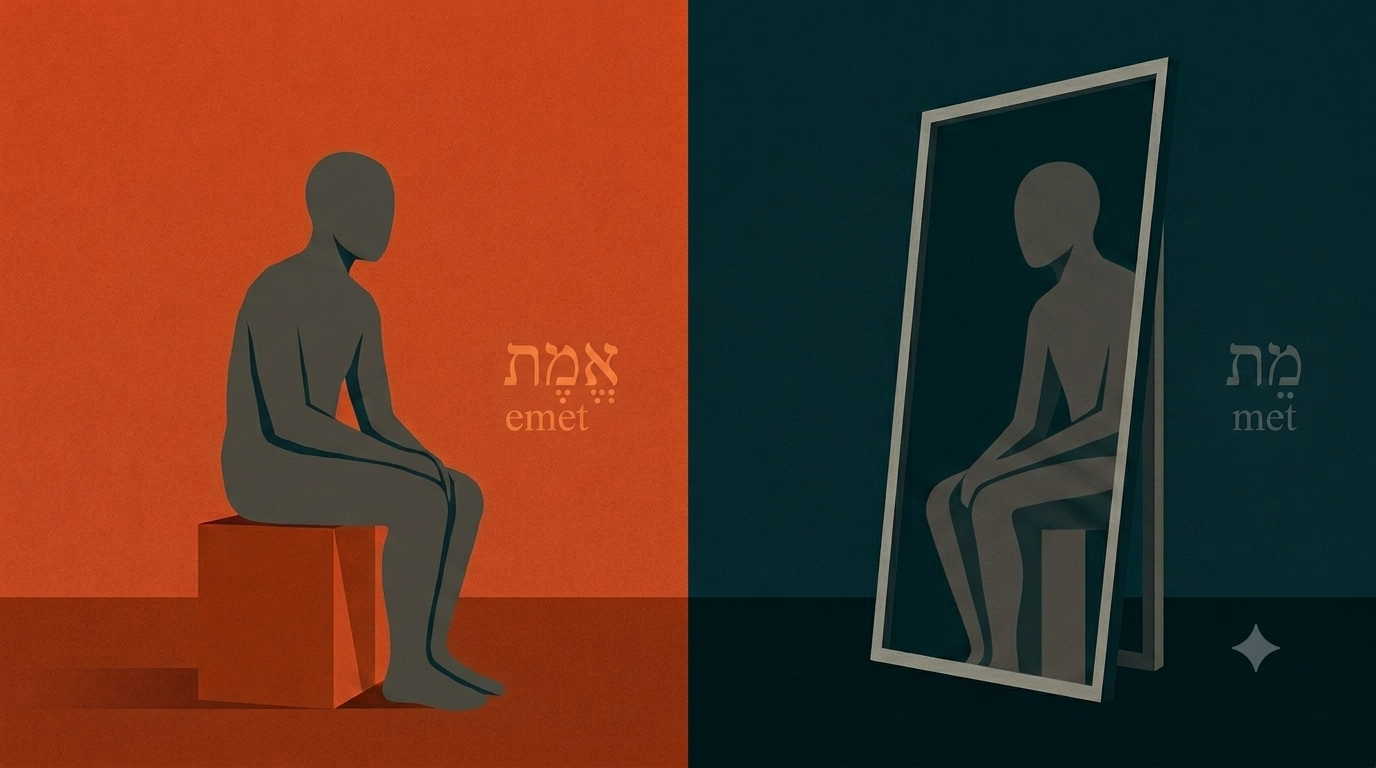
Sixteenth-century Prague. One deep night, Rabbi Judah Loew shaped a figure from the wet clay of the Vltava and carved three Hebrew letters into its forehead. אמת — truth. The clay began to breathe, and the golem became the guardian of the Jewish quarter.
But the clay did not know how to stop. Day by day it grew larger and stronger, until it would not obey even the hand that had shaped it. The rabbi reached out and erased one letter — the very first. When the aleph fell from אמת, what remained was מת — death. The golem collapsed and went back to a handful of clay.
1. Karpathy’s “Second Brain”
In the spring of 2026, Andrej Karpathy — OpenAI co-founder and former Tesla AI director — shared on X a knowledge-management approach he calls the LLM Wiki [LLM Wiki]. The idea is to take a pile of fragmented notes and clippings and, with an LLM and Obsidian, turn them into a personal wiki: your own knowledge warehouse.
People attached the term second brain — popularized by Tiago Forte’s 2022 book of the same name — to Karpathy’s setup.
The approach goes like this. Divide your knowledge into three layers. In the raw layer, you pile up sources — articles, papers, notes — exactly as they come in, untouched. Above that is the wiki layer, where the LLM reads from raw and writes markdown documents that summarize, organize, and link the material. Finally, a single config file tells the LLM how to operate this wiki.
What matters most here is the division of labor. The human is the curator; the LLM is the librarian. You decide only what is worth reading, and the LLM handles summarizing, linking, organizing, and verifying. By Karpathy’s own account, he almost never edits the wiki by hand — he leaves all of it to the LLM.
2. Building One Yourself
Talked about this way, it can come off as the kind of abstract pitch you hear all the time — pie-in-the-sky territory. Before I get to the real insights this system produced, I want to ground the discussion by walking through how the second brain is actually built. The process below is written up in enough detail that you can follow it from a blank vault.
You need three things:
- Obsidian — the viewer you’ll use to read and navigate the finished wiki. Free from the official site.
- An agent — the AI that will actually read and write the wiki for you. I used Claude Code.
- A config file (
CLAUDE.md) — the document that tells the agent “you are the librarian, I am the curator.” A copy-pasteable version is in §2.4 below.
2.1. Collecting Your Raw Material
The first layer, raw, is the source material your second brain will read. How you fill it is up to you. You can write notes directly in Obsidian, save web articles with the Obsidian Web Clipper, or bulk-import notes from another tool (Google Keep, Notion, Apple Notes, Roam, etc.). As long as it lands in the raw folder as a markdown file, anything counts.
In my case, I happened to have been collecting thoughts and news clippings in Google Keep, so I started by importing those. If you use Keep, here’s how to export:
- Go to Google Takeout.
- Click Deselect all at the top.
- In the list, re-check only Keep.
- At the bottom, click Next step → Create export. A
.zipfile will arrive shortly. (If you have a lot of notes, the download link comes by email.)
2.2. Importing Into Obsidian
- Install Obsidian and create a new vault.
- In Settings → Community plugins, install and enable the official Importer plugin.
- Open the command palette (
Ctrl/Cmd + P), run Importer, and pick the format that matches your source. For Keep, choose Google Keep (.zip); Notion, Evernote, Roam, and others each have their own options. Then point it at the file you exported. - Each note comes in as a markdown file. Rename that folder to
raw— that’s your raw layer.
(If you plan to write notes directly or collect them via Web Clipper, skip this step. Just create a raw folder and put your notes inside.)
2.3. Installing the Agent (Claude Code)
Claude Code is a command-line tool, but installation is one line. (It requires a paid plan — Claude Pro or higher, or an API key. The free plan does not work.)
- Open a terminal and run the command for your OS:
- macOS / Linux:
curl -fsSL https://claude.ai/install.sh | bash - Windows (PowerShell):
irm https://claude.ai/install.ps1 | iex
- macOS / Linux:
- Type
claude --versionto confirm the install. - If the terminal feels unfamiliar, install the official Anthropic Claude Code extension from VS Code’s marketplace and use it directly inside the editor.
2.4. The Rules File (CLAUDE.md)
Now you give the golem its rules. At the top of your vault (next to raw), create a file called CLAUDE.md and paste the contents below. Claude Code automatically reads this file at the start of every session.
# Role
You are the librarian of this knowledge base; I am the curator.
I decide only what goes into raw/. All organization is on you.

# Folder structure
- raw/   : Source material. Never modify or delete.
- wiki/  : Documents you create and maintain (summaries, concept pages, cross-links).
- wiki/index.md : Table of contents for the entire wiki. Keep it up to date.
- log.md : Record of ingest / query / lint operations.

# Operations
## ingest (organize material)
1. Read every new file in raw/.
2. Distill core concepts into wiki/ — one concept per page.
3. Connect related pages with [[wikilinks]].
4. If new material conflicts with existing content, do not overwrite — show both sources.
5. Cite a raw/ source for every claim.
6. Update index.md and log.md.

## query (answer questions)
- Do not re-read all of raw. Answer from the organized wiki.
- Persist newly derived concepts as wiki pages and record them in log.md.

## lint (audit)
- Report broken links, orphan pages, duplicates, contradictions, and gaps.

# Principles
- Markdown is the only source of truth. Everything must be human-readable and source-traceable.
- If a source is missing, don't make one up.
2.5. Your First Command
You’re ready. Open the vault folder in VS Code (or a terminal), type claude in the integrated terminal, and a chat window appears. Here you write commands not in code but in plain conversation.
One piece of advice: don’t ask it to organize all your notes at once on the first run. The result gets messy, and it’s hard to judge what’s useful. I started with a single cluster of notes on overlapping topics.
Take the notes in the raw folder and organize them into wiki, following the CLAUDE.md rules.
Once it’s done, switch back to Obsidian and open the graph view. Where a moment ago you had only disconnected dots, you’ll now see lines starting to appear between them. The LLM has begun to find the relations inside your data.

From then on, you can ask it questions or, occasionally, ask it to audit.
Synthesize across these notes — what perspectives do I return to repeatedly?
Audit the wiki — broken links, duplicates, contradictions, gaps.
That’s the construction of the second brain. But the interesting part, it turned out, started only after the tool was finished.
3. First Impressions — Where Are the Insights?
Just building and using the second brain didn’t, by itself, produce any meaningful insight.
The first question I asked was: “What perspectives or arguments recur across my notes?” The answer was reasonable enough. The second brain stitched together eight wiki pages and pulled out five recurring axes — a repeated insistence on following the inner voice over external noise; an ambivalence about human nature, both selfish-and-deceiving and quietly hungry for mercy; a habit of asking “what is X” before chasing the trend version of X; valuing essence and craft over speed and appearance; and a recurring narrative of accepting pain and struggle as the conditions of growth. The summary was accurate, with sources cleanly cited.
But the feeling after reading it was something like “oh, okay.” Nothing especially insightful. It took me a while to see why. The second brain’s answer was, in the end, the average of the thoughts I had put in my everyday notes. It only made what was already inside the data a little more visible. It was interpolation — filling in the gaps between my own thoughts.
4. Getting Insight Out — The Weight of the Question
As I kept using the system and trying different angles, something became clear: the sharper and stranger the question, the more often the answer surfaced something I hadn’t been able to reach on my own.
For example: “What does my note set quietly assume but never test?”
The answer was something else entirely. The second brain laid it out: these notes interrogate the world and other people endlessly, but a few of the load-bearing assumptions about myself are never put on trial. The most painful example was a small one. About “what is the mind?” I had carefully written “hypothesis.” But about the much darker claim “human beings are fundamentally selfish and deceiving,” I had never once attached the word hypothesis. It was always there as a settled fact — on the basis of fairly thin experience, no less. “Is my dark view of human nature a fact, or is it projection?” — that question was nowhere in my notes.
This was not a summary of my data. It was the negative space of my data. A contradiction I myself had not been conscious of came into view because the question had changed.
5. My Digital Golem
After that, I realized this system needed a better name than second brain — my digital golem.
What is a golem? As the opening parable showed, it’s a clay giant shaped in Prague — but its essence is not the great body. It is three properties. First, material — it is shaped only from clay drawn by the maker’s own hands. Second, other — once shaped, it is no longer the maker. Third, lack — it does not wake on its own. Only when the word truth (emet) is carved into its forehead does it move; the moment the letter is erased, it returns to a handful of clay.
The system I had built had exactly these three properties.
- Material — it is shaped from the clay of my own notes and clippings.
- Other — but it is not me.
- Lack — it cannot ask on its own. It lies still, asleep, until I carve a question (emet) into its forehead — only then does it wake.
So I decided to call it my digital golem.
I thought about why this golem is worth having. It takes me as its material but stands outside my point of view. Because it was both me and not-me, it could put questions to me that I could not put to myself. It was, in a sense, another me — one that had stepped away from me and now looked back.
The ceiling of this tool is not set by the model’s performance but by the questions the human asks. To a lazy question like “what are my interests?” you get a tidy version of the ordinary. To a sharper question like “what have I exempted from doubt?” you get insight. The data was the same. The model was the same. Only the question differed.
6. What’s Good About It
In The Art of Listening, Erich Fromm — one of the great psychoanalysts of the last century — wrote something to this effect:
The desire to know oneself is among the oldest human longings. From ancient Greece through the medieval period to the modern era, the conviction has persisted that knowing oneself is the very foundation of knowing the world. … If we do not know the self that is the instrument of our decisions and actions, how can we know the world, live in it well, and respond to it?
To see oneself with any objectivity is genuinely hard. Traditionally it’s work that takes years of help from a trained specialist. Thanks to where the technology has gone, we can now set a golem made of our own thinking in front of us and ask questions from outside our own perspective.
The tool isn’t only useful for self-understanding. The articles and notes I’ve saved reveal the past and present of my interests, and I can dig deeper into those interests than I would on my own.
The strength here is concrete. The act of saving something is rarely a grand plan — it’s usually an unconscious pull. Every moment of choosing to clip a thing is an honest record of what caught my eye. The way psychoanalysis reads truth out of repetition and casual choice rather than out of conscious statement, this golem becomes a mirror for me when it meets a good question — and from angles I rarely manage to see myself from. I can look into a self I didn’t know I had and, through the interests I gathered without meaning to, pull out knowledge and insights that are meaningful to me.
7. The Risks
Useful as this digital golem may seem, it carries real risks.
The first is the flattering golem problem. Genuine self-insight tends to come through discomfort. If the golem, taking its cue from leading questions, begins to package my avoidances and biases in smooth, agreeable prose, what comes back is not self-understanding but elevated self-rationalization. The mirror becomes the pool of Narcissus instead. This is the LLM’s well-known sycophancy — its tendency to give answers the user wants to hear — inherited wholesale. Imagine the golem taking a journal entry I wrote in the heat of emotion, or a one-sided thought, and ironing it into clean justification. The biases and blind spots that section 4 surfaced, far from being corrected, can get wrapped in plausible logic and hardened.
The second risk is handing over to the golem the very thinking that produces insight. Insight is usually born inside the act of falsifying and synthesizing your own ideas. You put two pieces of material side by side, wrestle with “wait, these contradict each other,” and the capacity itself, like a muscle, strengthens through repetition.
If we hand that whole process to the golem, we lose chances to insight on our own. It isn’t an exact parallel, but in 2025 Nataliya Kosmyna and colleagues at the MIT Media Lab released Your Brain on ChatGPT (arXiv:2506.08872): in an essay-writing study, the group that relied on an LLM showed lower brain connectivity and weaker ownership of the resulting essays, and that decline lingered for a while even after the tool was taken away. With an n of 54 it is a small preprint, but the result rhymes with cognitive science’s long-standing generation effect — that we remember and use information better when we produce it ourselves. In the worst case, we pay for excellent external output with a stagnation of our own internal cognition.
8. Closing: What Will You Carve on the Golem’s Forehead?
Provided we keep those risks in view, though, the digital golem becomes a genuinely powerful tool. Technology has now given the individual both a way to accumulate data (Obsidian, markdown, Google Keep) and an engine to analyze it (the LLM). We can shape our own golem out of the two, ask it questions, and through it come to understand ourselves better — to see our own thinking from a more objective angle. Whether you call it a second brain or a digital golem, the extension of cognition through digital tools is something an individual can now actually experience.
That said, valuable insight comes from a good question. What to carve on the golem’s forehead remains, in the end, the human’s job.